
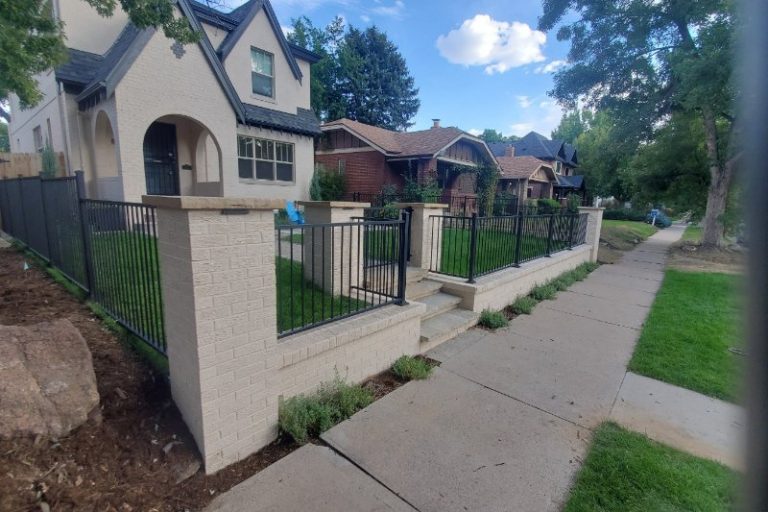
When someone calls us about a wrought iron fence, one of the first things I explain is that the fence they’re picturing is almost certainly made of steel. That’s fine. Steel is what we weld in our shop every week, and for most Denver yards it’s the right call. But if you’re comparing quotes, or trying to decide between an iron look and an aluminum fence from a big box store, it helps to know what you’re actually buying.
Here’s the short version. True wrought iron is a historic material. The last mills that made it at commercial scale closed more than fifty years ago, so almost nobody builds new fences out of it. Steel is what most people mean today when they say wrought iron. It’s much stronger than aluminum and the easiest of the three to customize. Aluminum is lighter, won’t rust, and usually costs less, but it gives up strength and is harder to customize. The right choice depends on what the fence needs to do.
What wrought iron actually is
Wrought iron is iron with very little carbon and fibers of slag running through it. Blacksmiths heated it and worked it by hand, which is where the name comes from. It’s tough, and it bends before it breaks, which is why you still see it in old gates and railings that have been standing for a hundred years or more.
The catch is that making it was slow and expensive. Once mild steel could be produced cheaply, wrought iron faded out. If you own an older house in one of Denver’s historic neighborhoods, you may have a genuine piece of it in a front gate or a porch rail. Repairing or matching that kind of work is a different job from building a new fence, and it’s worth talking through in person.
For a new fence, the honest answer is that wrought iron has become a style name. It describes the look: black pickets, rails, finials, scrolls, maybe a decorative arch over the gate. The metal underneath is steel.
Why steel took over
Steel gives you the look people loved about wrought iron, with far more consistency, and it costs much less to make. It welds cleanly, so a fabricator can build a fence panel or a gate as one rigid piece. That rigidity is the whole point. A welded steel fence stays square, the pickets don’t work loose, and a gate built that way keeps swinging and latching the way it did the day it went in.
Every iron and steel fence we build is fabricated in our own shop. Because of that, we can match an existing fence on the property, build to an opening that isn’t a standard width, or add detail like a custom top rail or a scroll at the gate. You can see some of that work on our wrought iron fence page.
The one thing steel asks of you is protection from rust. Bare steel will rust, so the finish is everything. A good primer and paint system or a powder coat is what keeps it looking right. I wrote more about that in an older post on dealing with rust on an iron fence.
Where aluminum fits
Aluminum fencing is usually sold as prefabricated panels in a handful of standard heights and styles. From the street it can look a lot like steel, especially in black. It’s light, it’s easy to ship and handle, and it doesn’t rust the way steel does, so it’s popular around pools and in humid parts of the country.
Where aluminum falls short is strength. The pickets and rails are thinner and softer than steel, so a ladder, a snowblower, a dog that jumps at it, or a car door can bend it. Many aluminum systems are put together with screws or brackets instead of welds, which is fine for a decorative fence but leaves more joints to loosen over time. And because the panels come from a catalog, you’re limited to what the manufacturer makes. If your yard has a slope, an odd opening, or an existing fence to match, aluminum gets harder to work with.
Aluminum also isn’t a great choice for a wide driveway gate. A big gate needs a rigid frame to keep from sagging and twisting, especially if it’s going to be automated. That’s a job for steel.
How each one holds up in Colorado
Denver’s dry air is actually kind to metal fences compared to the coasts. Where we see rust start is low on the fence: the bottom rail where snow sits for days, the posts near a sprinkler head that hits them every summer morning, and sections near a driveway or sidewalk where de-icer gets thrown around in winter. If you go with steel, keep sprinklers aimed away from the fence and touch up chips in the finish before water gets under them. Our post on keeping a wrought iron fence looking new walks through the basics.
Sun is the other factor. At our altitude the UV is strong, and a cheap finish on any metal fence will fade and chalk. Ask whoever is quoting your fence what finish they use and how it’s applied.
Wind matters too. An open picket fence lets wind pass through, which is one reason metal fences ride out Front Range windstorms better than solid privacy fences. Steel’s weight and rigidity help here as well.
Security and gates
If security is part of the reason you want a fence, steel wins. It’s harder to bend, harder to climb when it’s built with the right picket spacing and top, and it holds a lock and latch without flexing. For businesses and HOAs, steel is the standard for that reason.
Gates are where the difference really shows. A walk gate gets opened thousands of times a year, and a driveway gate carries real weight on its hinges. A welded steel gate with properly sized hinges and posts will stay level for years. If you’re thinking about a gate that opens on its own, we build those too, from the frame to the opener. Our automatic gate systems page covers swing, slide and cantilever options.
Looks and custom work
All three materials can look great. Aluminum gives you a clean, uniform look from a catalog. Steel gives you that look too, plus the option to make the fence your own. We’ve built steel fences with flat tops, spear tops, arched sections, horizontal designs, and panels set between stone or brick columns. If you have an idea in your head, or a photo of a fence you liked, bring it to the estimate. The custom gates we build show the kind of detail that’s possible when the fabrication happens in house.
Cost, in plain terms
I won’t put numbers in a blog post, because every yard is different and prices for metal move around. In general, prefabricated aluminum costs less than custom steel, and steel costs less than restoring or reproducing true wrought iron. What drives the price of a steel fence is mostly height, length, how ornate the design is, the number of gates, and how hard the site is to work on. Aluminum’s lower price can come with a shorter useful life in a yard that’s hard on fences, so it’s worth weighing how many years each option will give you.
How I’d choose
If you want a decorative fence around a pool or a front garden, the ground is flat, and nobody is going to lean on it, aluminum can do the job.
If the fence is going to take abuse from kids, dogs, snow and wind, if security matters, if there’s a driveway gate involved, or if you want something built to fit your property instead of picked from a catalog, go with steel.
If you have real antique wrought iron on an older home, take care of it. It’s worth keeping.
We’ll give you a straight answer on which one makes sense for your yard. Send us the details and a few photos if you have them, and we’ll set up a free estimate.